Showing posts with label The Great Wheat Experiment. Show all posts

Saturday, July 16, 2011

Harvest Time

I looked at my wheat today and noticed that most of the heads were bending down.  So I tested a grain and it was firm and crunchy, and I figured that it was time to harvest.


I figured that harvesting was definitely a two-man job, so Michael obligingly stepped in as my helper to get everything cut and tied.  I was telling him earlier today about needing help with the project, and I sang, "Will you help me harvest my grain?  Will you help me harvest my grain?" Then I said, "See?  You have to help me because if you don't I'll have to sing that song from the Disney cartoon and then you won't get to eat any bread when I'm done."

To which Michael replied, "I'm gonna need to see this cartoon before we go any further."

It turned out that he helped me even without seeing the video, so that was lucky.  Anyway, as we all probably know, the old-timey way of harvesting grain is with a scythe or a sickle, which basically just cut down the stalks and then you lay them together and bind them.  The reason I wanted Michael's help was so that he could do this:


He'd just grab a bunch of stalks and then I used long clippers and just clipped the bottoms of the stalks and we'd do an entire row like that.  Once we had clipped a whole row, Michael would hold all the stalks together while I tied a string around them to make sheaves.  Here's what my handy website says about that:

The next step is to bind the grain into sheaves, each about 12 to 14 inches in circumference — a bunch you can hold comfortably in your hands. Bind the same day you cut the wheat. It’s nice to have two people taking turns cutting and binding. You can bind with cord or baler’s twine or even with some of the wheat stems, twisting them in a way that holds the bundle firm.

So we just bound each row into one sheave and moved on, and the whole harvesting process took about 20 or 25 minutes.  Here's what all of my sheaves looked like when we were done, aren't they pretty?


And here's what my plot looked like when we were through, just a little bit sad:


The next step of the process, curing, sounds easy enough:

Curing the grain. Stack sheaves upright in a well-ventilated, dry location safe from grain-eating animals. Our ancestors stacked sheaves to make shocks in the field, but with small quantities, it’s easy to bring the sheaves in out of the weather. The grain has been cured when it is hard, shatters easily and cannot be dented with your thumbnail.


I have a little work shed in the backyard so I propped my sheaves up in there.  I really don't think they have far to go to get cured and once that's done it's time for threshing and winnowing.  Apart from preparing the plot last fall for the seeds to go in (pulling up weeds, pulling out roots, and digging rows), I'm afraid that threshing will be the most labor intensive part of this process so far.  I have a feeling that I will have to wait until I'm really frustrated and I just want to beat the hell out of something.  Because that's what it's going to take!  So if anyone has an bad news they've been waiting to give me, now's the time. =)


P.S. Now that things are harvested, there are a couple of things that I wish I would have done differently:
1. I wish I had made my rows farther apart.  I think I did them so close together because I had so much seed (and tons left over), and I was trying to get as much in as possible, but it really made weeding difficult.
2. I would lay down a layer of newspaper between each of the rows to discourage weeds from growing between them.  I did consider using some weed killer this year, but I just felt weird about putting down harmful chemicals adjacent to something that was going to potentially grow and possibly feed my baby.  I'm sure that a lot of foods we eat daily are grown in exactly this way, but when the power was in my hands to put those chemicals there or not, I chose not to.

Friday, July 8, 2011

My tribute to the 4th of July: Amber waves of grain!

Well,  in the last few weeks my wheat made the magical change from pale green to lovely amber... or at least pale yellow.


This little guy is still working on shedding that green color.
You can do it!

As beautiful as it looks, it's still not ready to harvest. I found a website that does a good job of describing when to harvest:

"As you admire your wheat stand, you’ll notice in midsummer that the color of the stalks turns from green to yellow or brown. The heads, heavy with grain, tip toward the earth. This means it’s time to test the grain. Choose a head, pick out a few grains, and pop them into your mouth. If they are soft and doughy, the grain is not yet ready. Keep testing. One day the grains will be firm and crunchy, and it will be time to harvest."

I "tested" a grain today, and it was soft and doughy.  Once it's finally ready I'll have these steps left: harvesting, binding, curing, threshing, and winnowing.  The only one that intimidates me is threshing.  I've read some suggestions as to how to do this on a small scale.  One suggestion I like is to stick the sheaves in a pillowcase and bash the heads against a brick wall.  The grains are supposed to fall out of the heads and then they're ready for winnowing.  I'll be taking photos of all of these steps as I do them...  I just sure hope those grains come out.

So my little wheat plot went from its humble beginnings last fall:


To today in early July:


I don't know about you, but I find that just amazing.  Mostly because I didn't expect it to work so well.  But everything has been going well so far, let's hope that it stays that way!

Thursday, June 2, 2011

Wheat Update: Is it alive?

Everyone has been asking me about my wheat.  How's your wheat?  Did it survive the winter?

The answer is YES.  Behold:


It survived, along with a bunch of weeds that grew up in between the rows making everything almost indistinguishable.  The light-colored tufts you see in the picture above are the weeds.  Here are my first efforts at weeding, in which I pretty much just give the weeds a haircut:


I took these pictures in early May, so these pictures are a little old.
I still have to weed about half of the plot, but between work and a toddler and a husband who isn't awake during the day, it seems impossible.  But little by little, hopefully it will get done. 

Well, I started feeling guilty for giving you pictures from a month ago, so I went and snapped some just now.  Here's what it's looking like today:


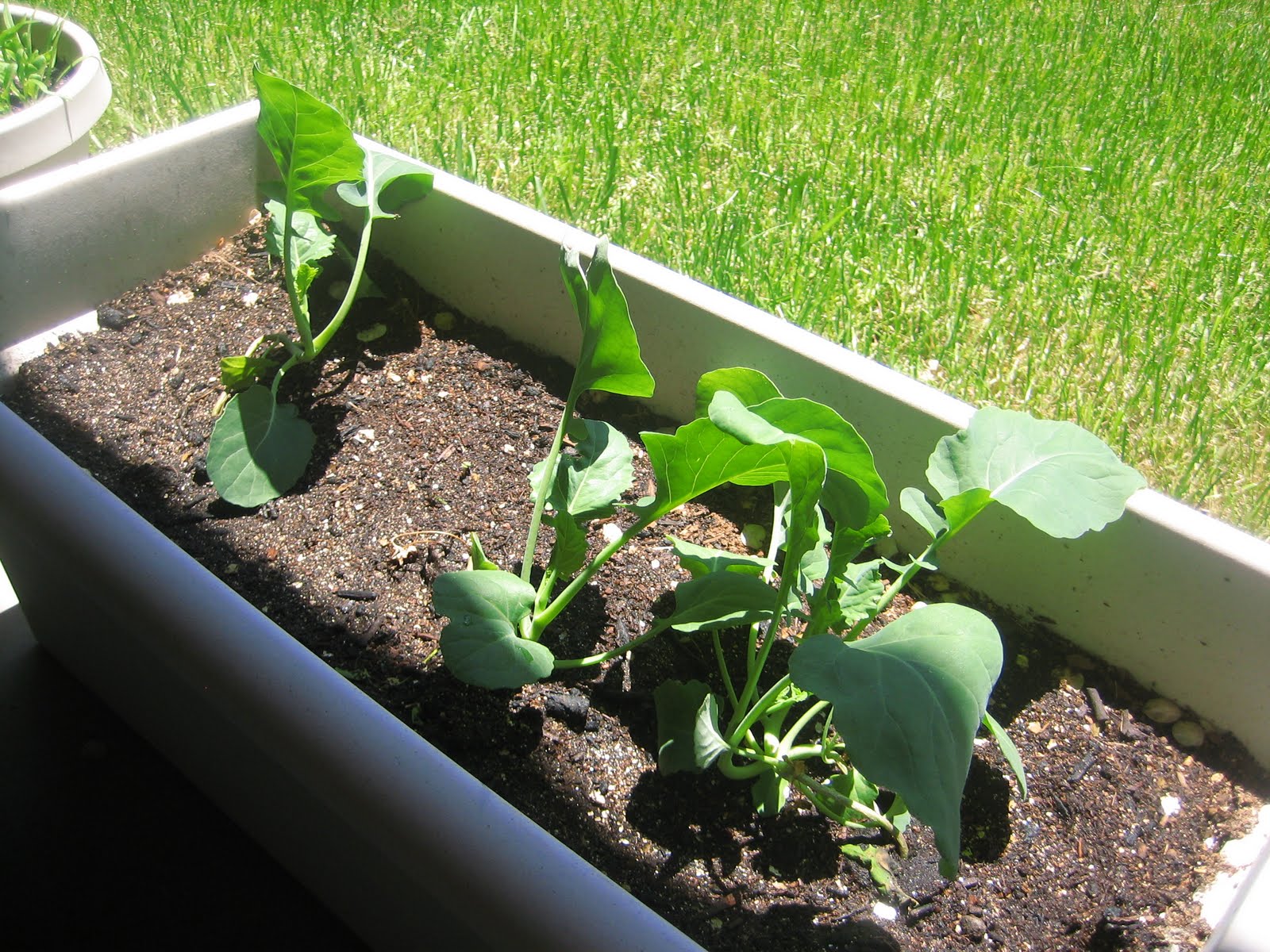
Amazing, right?  Even a bonehead like me could grow them.  I've also got all sorts of other little miracles popping up in the planters on my patio:

Broccoli

Green beans

A melon (I'm hoping for honeydew but I'm not sure)


Herbs, I think Basil and Parsley

Zucchini

This is the first year that I've ever really tried to grow anything, and I'm sure not everything will work out, but I'm learning a lot (for instance: the plants like to be watered EVERY day... huh). 

I got Jane a teeny, tiny watering can so she can "help" me water our garden.  The first time I gave it to her she didn't let go of it for 40 minutes.  She sure is doing a lot of growing herself!


Thursday, October 7, 2010

Sunday, September 26, 2010

Ma wheat done sprouted!


Unfortunately I also noticed a whole bunch of these guys:


Apparently, they like to eat nice, tender sprouts.  A LOT.  I do have to say that they are kind of the big, dumb, slow specimens of the insect world.  I made a trip to my local Intermountain Farmer's store and found a pesticide that's safe to use on edible plants.  I felt sort of defeated, though, having to resort to a pesticide.  Maybe I could have stood out there all day and hacked them to death every time they came near my wheat sprouts.  But who would watch the baby?  Plus, that got old after killing the first one.  The dumbest part was that I literally felt guilty.  And then I asked myself how I possibly think I could kill a chicken when hacking a grasshopper had my gut clenched with guilt!  Yeah, good luck with that one, crazy.

Anyway, my wheat sprouted!  It's ALIVE!

Sunday, September 19, 2010

The Great Wheat Experiment, Part 2

(Read Part 1 here)

I would just like to point out before we get started that my mom is mad at me for growing something that she and all of my sisters can't eat.  Sorry, guys.  But it's the staff of life, baby!  Well, not your life.  But mine.  And lots of other people's.

As I started looking into growing your own wheat, I found that there are two types of wheat, spring wheat and winter wheat.  Winter wheat you plant in the fall and it sprouts, then it lays under the snow during winter and grows back in the spring.  You harvest it in June or July.  You're supposed to plant a few weeks before the ground actually freezes, so by the time I got this crazy notion into my head, it meant it was time to plant already.  Yikes!

So it looks like for every pound of seed that you plant, you get about 8 times that amount when you harvest.  I read one site that suggested starting with a small amount, like 6 pounds of seed.  I called my local IFA store and asked for winter wheat seed.  The guy on the phone said, "Oh, I only have a little bit left.  Just two 50 pound bags."  I laughed and told him it was more than enough.  Apparently, people planting wheat around here do a much larger-scale operation.

I went and bought one of the bags, which cost about $13.  Except that they gave me a discount, because he said the seed was a little older and not every seed would sprout.  So the 50 lb bag cost me about $7.50.  I had the seed.  Check.

The harder part was getting the ground ready.  I had an unused part of my backyard that had been overgrown by weeds, so we had those weed-whacked and then I had to rake the remains out.


I discovered some things about this area of the yard.

1. It used to be a lawn with grass.
2. Grass is hard to pull up.
3. There used to be a massive tree in this area, as evidenced by the large trunk and even larger root system running through where I wanted to plant.
4. Tree roots suck.

A lot of my time was spent pulling out the green bush that you see on the left in the photo.  That's where I found the tree trunk.  Also digging up the clumps of grass was challenging.  I finally got it to this point:


I like to call that thing in the middle there the Giant Root of Death.  It had to go.  I tried making a furrow with it in there, and it was totally uneven.  So I got out the hatchet and chopped, chopped, chopped at it (what I would have given for an axe.  Or a CHAINSAW).  Michael helped me pull it up, and after a sunburn and a few blisters, the ground finally looked like this:


The whole process of clearing this space out was done over a couple of weeks, during Jane's naps, by me, me, and ME.  I felt like the little red hen ("Will no one help me plant my corn?") and kept getting the Disney song stuck in my head while I hacked away at the soil.  Not that I had asked anyone for help.  And Michael did help me with the large roots.  I was also stressed out trying to get the seed in the soil fast enough to give it a chance to grow a little before the ground freezes, and I did the best I could and we'll just have to see what happens next year.

So what about the actual planting?  It sounds like you can just throw the seed out in the area, and then rake it into the soil.  It should be covered by 2 to 2 1/2 inches of soil, and it didn't seem like raking could do that very reliably.  You can also plant it in rows.  One site suggested that you make holes every six inches and put seeds in.  But the IFA Store Guy told me to plant my seed twice as thick as I normally would (hah, normally would?  If I had ever done it before) because the seed was older and not all of them would sprout.  So I decided to go with rows, and instead of spacing things out every six inches, I just laid down a line of seed in each furrow.

Check out ma rows:


And ma wheat:


Like I said, it looks like for every pound you plant, you can harvest up to 8 times that amount in the spring.  But then again the IFA Store Guy told me that not all of my seed would sprout.  Tricky.  Here's how I laid it down:


Looking at it now, it looks pretty dense.  But what do I know?  I'm no farmer.  I'm just some schluck who decided to try planting wheat.  Maybe next spring it'll all crowd and smother each other.  Maybe the grasshoppers will eat half of the stems that come up.  Oh well.  It's my first try and I'm not really stressed about it coming out perfect.  If I had to guess how much went in, I'd say maybe 10-15 lbs.  Will I have 80 lbs of wheat next summer?  We'll just have to see what happens.

What about watering?  Apparently, wheat likes dry weather.  I've read that you water it when you plant it, and then only water again if it's looking parched, even in the spring.  I guess whatever rain it might get is enough?  At any rate, I'm glad that it's in and can start growing.  I'm actually just happy with what I've done so far.  Sometimes life feels like I'm accomplishing nothing.  But it's been really satisfying to look at those photos, before and after, and see that I really did this, and almost completely by myself.  Big pat on the back for me!

Saturday, September 18, 2010

My Food Revolution: The Great Wheat Experiment, Part 1

Last year I read Michael Pollan's In Defense of Food, which largely discusses processed food and how we get fewer nutrients and less overall goodness the more our food is processed.  He encourages his readers to eat food (real food, not unrecognizable processed inventions), not too much, and mostly plants.  I had never really thought about the processing our food goes through before I read his book, and I had never really cared.  But in the months afterward, I thought more about it and looked with more scrutiny on the things that I was getting from the grocery store.

Another book that has had an interesting influence on me is Life As We Knew It, a young adult novel about a teenager living a normal high school life when the moon is struck by an asteroid and knocked closer to earth, causing the tides to turn into tidal waves, volcanic magma to be pulled up through the earth's crust into volcanoes, crazy storms, and all sorts of mayhem.  The book follows this girl as she and her family try to survive inside their own house while the rest of society basically breaks down and their electricity, gas, and food sources slowly dwindle off.

So what does that have to do with food?  That book really freaked me out, and for several days afterward I kept trying to figure out how Michael and I would fare in a similar situation.  My conclusion: we'd be screwed.  I realized how much I depend on the grocery store and large companies to produce, create, process, and package things I use everyday.  Necessities.

Self-sustainability isn't something I ever really cared about before, until I realized that I can't really do it.  I thought about starting a vegetable garden, but on a practical level it seems a little silly when I am inundated every week with a large basket of produce that I try my best to use every piece of.  Plus, my now paranoid brain told me, if I was truly forced to be self-sustaining, I'd probably go nuts on only vegetables.  Meat production is something that I've honestly thought about, wondering if I could really kill a chicken.  I think I'm content to leave that as a speculation for now.

So I started thinking about flour.  Wondering what I am really getting from the store.  The flour is processed (who knows how?), bleached, and then nutrients are added back into the bread.  One point in In Defense of Food is that for some reason, people who had a whole food (rather than a food that had been processed and had nutrients added back in) fared nutritionally better.  Even if, as far as science can tell, they are getting the same nutrients.  For some unaccounted for reason, the whole foods nourish better than foods that are broken down and then put back together in terms of separate nutrients.

For my birthday, I received a grain mill from Michael's wonderful parents.  I'd been intrigued by the prospect of grinding my own wheat, even though I can't remember where to get wheat for grinding.  So then I thought - what if I made bread from scratch?  Like, really from scratch.  As in: grow the wheat myself?  Because really, what do I even know about seed that I'm getting from the store?  What fertilizers, pesticides, gathering methods, kind of storage has it gone through before it got to me?  As you can tell with my investigation into meat, I'm really starting to wonder how foods are produced and brought to us, and the less I understand about that process, the more helpless I feel.

So, in the interest of experimentation, I started researching how to grow wheat.

Now I will tell you all the edible plants that I've grown before: basil.  That I bought pre-grown from the store.  I bought some seeds, too, and planted those, and they are sort of thinking about growing up.  I manage to water the large basil and the seedlings most days.  I use them in cooking a lot and it has actually saved me a bundle because buying fresh herbs from the store is highway robbery.  That's pretty much it.

So am I crazy for thinking I can grow a crop?  Yup.

Bring it on.

Also, is it unpractical?  Pretty much.  I'm certainly not doing it for the money.  Flour is just about as cheap as the dirt you can buy in the store.  Maybe cheaper than dirt.  I'm not really doing this to try to save money.  I think it's more about the challenge.  I want to see if I can really do it, if it's possible (and maybe sleep better knowing if an asteroid hits the moon, I might have a backup plan).  Also, I'm starting to really value knowing exactly what has gone into my food and how it got on my plate. 

So that's the why.  Part 2 (and the following parts) will be about the how.
Part 2 will be coming very soon.  Because guess what?  Planting season is NOW.